

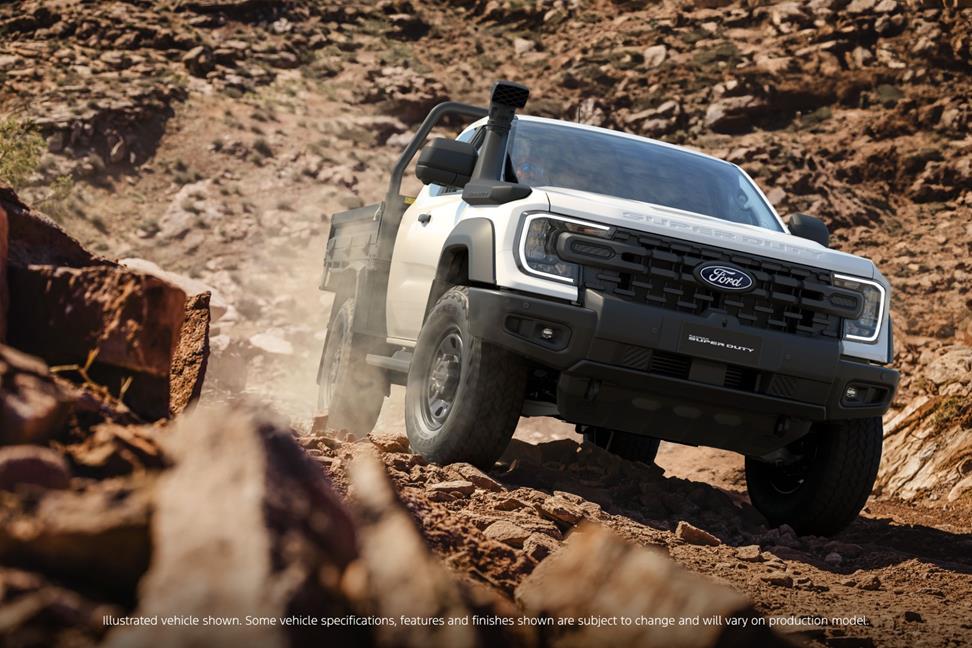
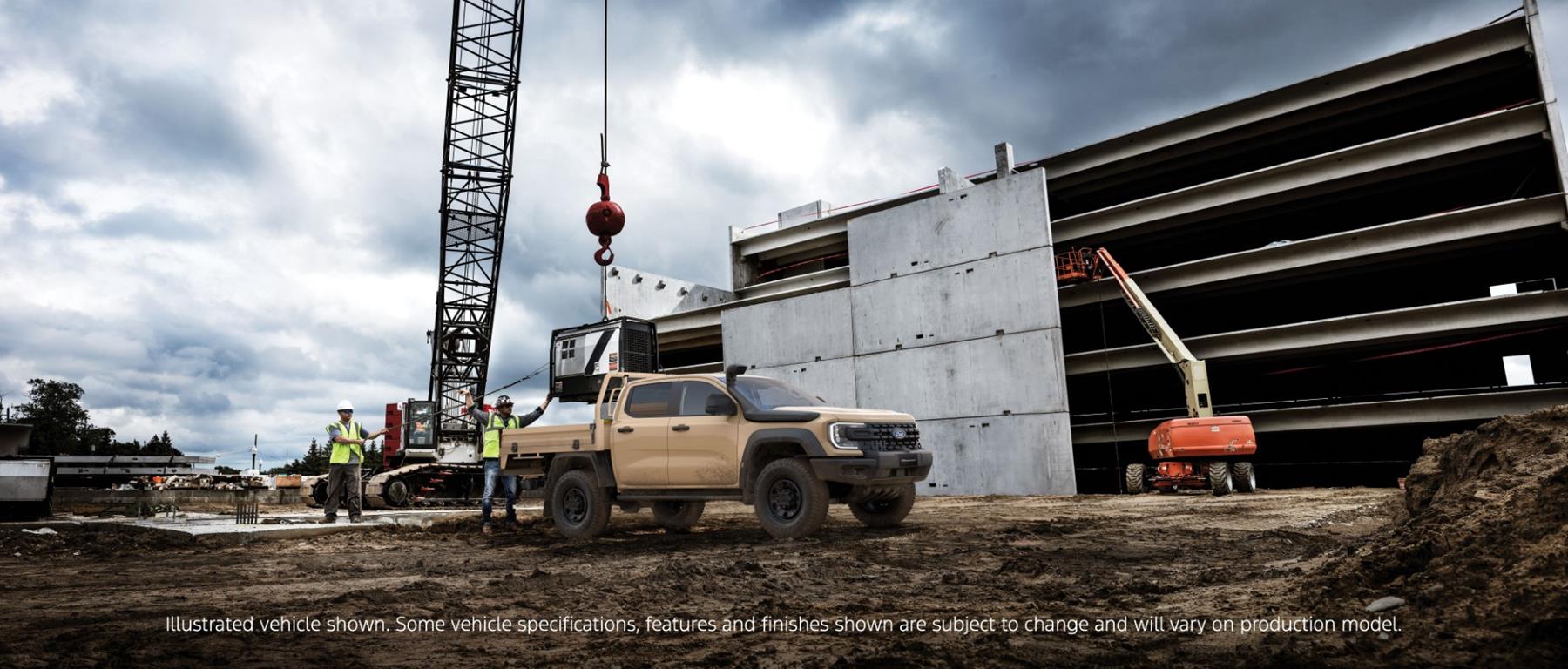
Ford has confirmed its inaugural Ranger Super Duty model will reach South African shores in 2027, with a staggered introduction of body configurations that includes Single Chassis Cab, Super Chassis Cab, Double Cab Chassis Cab and a full Double Cab option.
The vehicle has been purpose-built for operators who rely on their bakkies for heavy haulage, towing and sustained workload demands and Ryan Searle, director of sales operations at Ford Motor Company of Southern Africa, said the development team had paid close attention to what clients in demanding sectors required from a workhorse.
He added the resulting vehicle incorporates heavy-duty hardware and enhanced functional capacity, allowing operators to extend their working hours and complete tasks with greater efficiency. Searle described the offering as taking global mid-size bakkie performance to a new tier, straight off the production line, while maintaining a tailored appeal for local Ford enthusiasts.
All the choices you could possibly want in our Ford Ranger treasure trove - click here
With a gross vehicle mass rating of 4 500 kilograms, the Ranger Super Duty falls into the Code 10 (C1) classification under South African regulations, underscoring its substantial load-bearing credentials. The factory-built solution is aimed at sectors such as agriculture, mining, lifestyle and professional services, where reliable towing performance is a non-negotiable requirement.
To earn the Super Duty badge, the vehicle has undergone an exacting durability regimen designed to simulate the harshest operational environments. Searle explained the testing protocols included an intensified mud pack trial, during which the bakkie had to remain fully functional even with 600 kilograms of mud adhering to its underside, replicating both mining site and recreational off-road conditions.
Some of the testing procedures proved so demanding Ford Australia resorted to autonomous driving robots to maintain continuous, round-the-clock assessments at the You Yangs Proving Ground. These robots recreated the punishing conditions of a dry, rugged riverbed. In addition, the Ranger Super Duty was subjected to standard durability benchmarks, including perpetual corrosion baths, towing dynamometer sessions, shaker rig evaluations, extreme real-world off-road driving, and low-speed, low-range hauling with heavy loads.
Beyond its outright towing figures, the Ranger Super Duty incorporates Ford’s Pro-Trailer Backup Assist, which simplifies reversing manoeuvres with trailer attached by using a yaw rate sensor to automatically regulate trailer angle. The system can store up to 10 trailer profiles and needs only a single calibration per trailer.
Smart Hitch and Onboard Scales are also featured. Smart Hitch assists drivers in gauging towball weight and adjusting trailer load distribution to prevent overloading or underloading. The standard towball handles 3 500 kilograms, while an upgraded option allows users to exploit the maximum towing limit of 4 500 kilograms. Suspension-mounted sensors at each wheel enable the Onboard Scales to estimate payload as items are loaded, with the information displayed on the SYNC screen. Users can also specify additional load data for more accurate estimations.
Can I afford it – find out with this handy Finance Calculator
Although the overall chassis dimensions remain consistent with the standard Ranger, the Super Duty variant employs a TT frame with increased thickness and reinforced suspension mounts, box mount brackets and tow bar mounts. These upgrades underpin the 4 500-kilogram GVM rating. Stronger front and rear driveshafts, along with a new heavy-duty rear axle, boost load capacity, and the rear differential is the largest and most robust ever fitted to a production Ranger. Eight-stud wheel hubs with larger bolts further aid load distribution.
The vehicle has been developed with upfitting in mind, featuring a reinforced frame and easily accessible mounting points to simplify the integration of accessories and specialist equipment through Ford Converter. Searle noted that these enhancements are central to the bakkie’s ability to carry and tow greater loads than any other factory-built mid-size pickup, while also improving durability and reliability for end-users.
Power comes from Ford’s 3,0-litre turbo-diesel V6, calibrated to meet heavy-duty emissions standards and delivering 154 kW and 600 Nm through a 10-speed automatic gearbox. Enhanced cooling systems maintain optimal temperature management under load and during extended off-road driving. A 130-litre long-range fuel tank is standard, with thick steel shielding guarding against impact damage in rough terrain.
Underbody protection includes high-strength steel bash plates covering the engine, front differential, transfer case, transmission and fuel tank. Searle said that given the extreme conditions in which the Ranger Super Duty is expected to operate, the shielding was a critical design consideration. Breathers for the differential, transmission, fuel system and transfer case have been mounted high to improve wading capability, which stands at 850 millimetres, while ground clearance approaches 300 millimetres.
The two-speed transfer case incorporates larger, stronger components than other Ranger models, and the low-range gearset has been upgraded for extreme terrain use. Front and rear locking differentials come as standard across all variants, with the front differential modified for increased load capacity.
Searle concluded that the Ranger Super Duty represents the sum of its engineering parts, and expressed confidence that whether used for extreme professional tasks or off-road exploration, the vehicle would deliver dependable performance.
Final pricing has not yet been set, but current market indicators suggest a recommended retail band starting from roughly R1 100 000 for the Single Chassis Cab and extending to about R1 300 000 for the Double Cab. Ford has stressed that official pricing will only be announced in 2027.
Colin Windell for Colin-on-Cars in association with
proudly CHANGECARS